
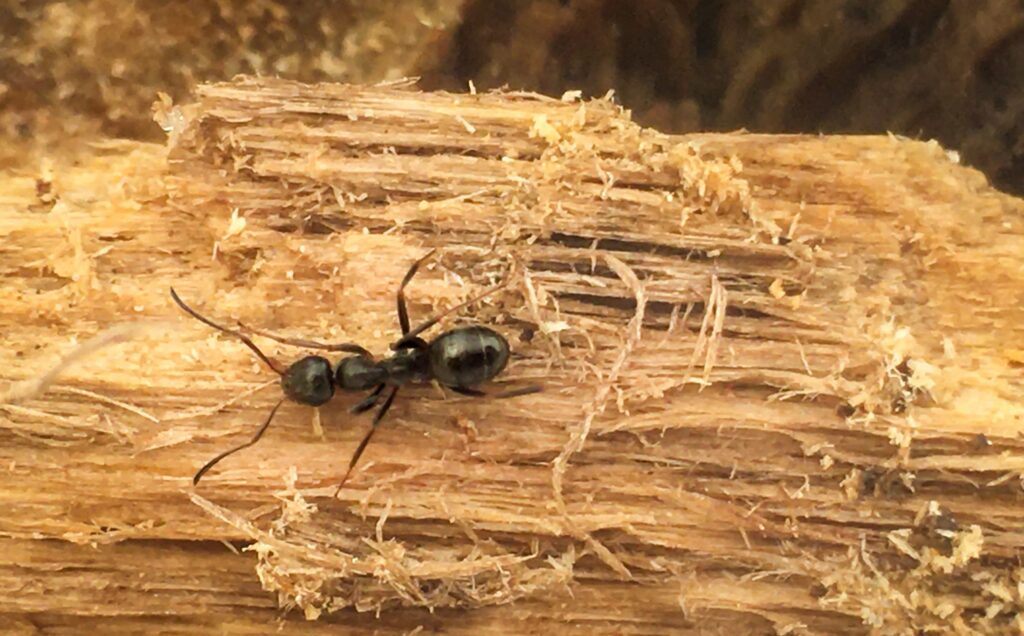
Quick answer: Repeated large-ant sightings, winged ants indoors or small piles of coarse wood shavings can justify a carpenter ant inspection. They do not prove where a colony is nesting. Check for moisture and record the location of each sign before deciding how to treat it.
Start with the evidence, not the neighbourhood
A Peterborough home downtown, in East City or elsewhere can have ants for different reasons. A trail may lead from an outdoor nest to food inside, while activity near damp wood may point to a nest in the structure. The property’s actual conditions matter more than a general claim about its age or proximity to the Otonabee River. Note whether the ants appear at a window, along a baseboard, near plumbing or on an exterior wall, and whether you see them repeatedly.
What should you look for?
- Shavings: Carpenter ants excavate galleries and push out sawdust-like material, sometimes with insect fragments. They do not eat the wood.
- Recurring activity: Photograph the ants and record the time, room and route. A few workers indoors could have travelled from outside.
- Winged ants: Save a clear photograph or specimen for identification rather than assuming every winged insect is a termite.
- Moisture: Look for a known leak, water-stained trim, soft wood or condensation near the sightings. Do not open walls solely to search for a nest.
These signs and the role of damp or decaying wood are explained in Health Canada’s carpenter ant guide. If you are unsure of the insect, a close photograph can help distinguish an ant from a termite or another species.
A practical walk-around checklist
From a safe, accessible position, check places where water can collect: a window or door frame that has leaked, a deck connection, roof or soffit damage, a basement sill, and the area around plumbing. Outside, note any decaying wood, stored firewood against the building or landscaping timber in contact with the structure. Check gutters and drainage only where you can do so safely. A moisture problem may need repair by a qualified trade even after the ants are controlled.
Keep a short log with the date, location, photograph and any known leak or prior treatment. Avoid spraying over the trail before an inspection if you can safely leave it undisturbed; it may make the route harder to trace. Keep food sealed and clean up crumbs, but do not assume kitchen sanitation alone resolves a colony associated with wood.
What does a professional inspection decide?
We first identify the insect and inspect the pattern of activity. The technician may check likely nesting or travel areas and explain whether treatment is warranted, which spaces require access, and what moisture or wood repairs should be addressed. Treatment, monitoring and repair are separate parts of a plan; ask which are included in the estimate and whether a follow-up is recommended. A promise to eliminate every ant permanently without finding the cause would not be useful.
Peterborough carpenter ant questions
Does seeing one large ant mean there is a nest inside?
No. It may be a forager from an outdoor colony. Repeated sightings, winged ants indoors or shavings near a consistent spot make a closer inspection more useful.
Do carpenter ants eat or damage wood?
They tunnel to make nesting galleries rather than eating the wood. The extent of any damage depends on the colony and affected material. Moisture and structural repairs may need separate attention.
Can I treat the visible trail myself?
Identify the species and read any product label first. Health Canada advises using products registered for the pest and following all label directions. Treating only the ants in view may leave a nest or moisture source unaddressed.
Request an inspection in Peterborough
Quality Affordable Pest Control can assess suspected carpenter ants in Peterborough and explain a property-specific plan. See our Peterborough pest control page and ant control service. Call (647) 502-3950 or request a free estimate. A photograph of the insect and any shavings will help us discuss the next step.
Leave a Reply